
Trailer Park Boys:Greasy Money
East Side Games StudioSimulation
4.654.77K Reviews
- Version
- 1.44.6
- Installs
- 5.00M
- Age Rating
- Mature 17+
Screenshots




Our Review of Trailer Park Boys:Greasy Money
 Analysis by Appyee
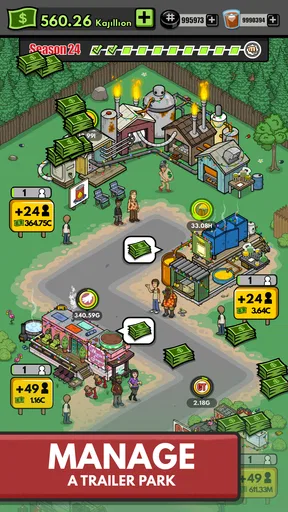
I approached Trailer Park Boys:Greasy Money expecting a light simulation game built around short sessions, and that is exactly where it makes the most sense. Developed by East Side Games Studio, this free mobile game turns the rough, comic world of Trailer Park Boys into an idle business-management loop. You tap, collect money, upgrade familiar operations, and gradually expand the park’s earning potential while the game keeps working in the background.
My main question was not whether it could keep me busy for a few minutes. It can. The more useful question is whether its particular mix of comedy, waiting, upgrades, and optional spending suits the way you like to play. If you enjoy checking a game several times during the day, making small improvements, and watching a messy operation become more profitable, there is a comfortable rhythm here. If you want a deep economy, direct control, or a game that never asks you to wait, the appeal is much narrower.
What to consider before you start
The first decision is about your relationship with idle games. This is a simulation game, but it is not a detailed management simulator in the traditional sense. You are not designing every corner of a park, negotiating complex contracts, or manually controlling every worker. Instead, the pleasure comes from choosing what to improve, collecting accumulated earnings, unlocking the next opportunity, and repeating that process with slightly better results.
That distinction matters because the game’s strongest moments are small and cumulative. I might open it while waiting for coffee, collect what has built up, spend the proceeds on an upgrade, and close it again. Later, the same upgraded operation produces more money, which gives me another reason to return. It is a good fit for fragmented attention rather than a long uninterrupted gaming session.
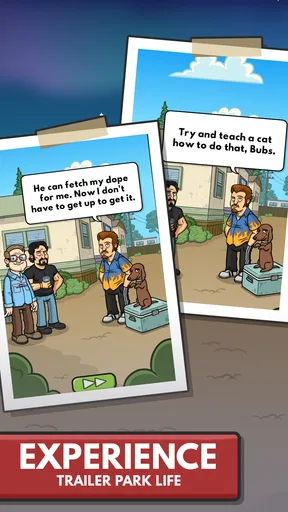
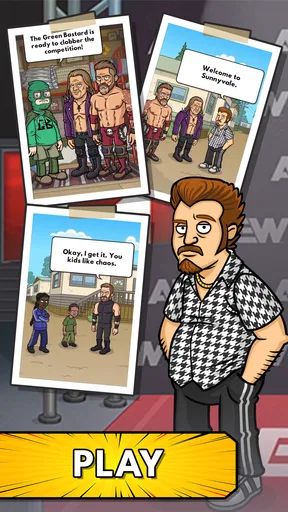
The Trailer Park Boys setting also shapes the experience more than a generic business theme would. The humor, characters, and deliberately scruffy atmosphere give the routine a recognizable personality. I found that the setting makes otherwise ordinary upgrade screens feel more entertaining, especially if you already know the show. Without that connection, the mechanics still function, but some of the charm becomes background decoration rather than a reason to keep playing.
There is a practical point for families and shared devices: the game carries a Mature 17+ content rating. I would not treat it as a general-audience idle game just because its controls are simple. The tone is aimed at adults familiar with the source material, so it belongs on a personal device rather than a child’s casual game folder.
The best way to judge its loop
I recommend giving the opening session a specific test instead of asking whether it is “fun” in the abstract. Notice whether you enjoy the sequence of collecting, upgrading, and checking progress. Also notice how you feel when the next improvement requires patience. That second reaction is important: the game is designed around anticipation, so players who dislike timers or repeated collection screens may lose interest even if they enjoy the theme.
My preferred approach is to treat each visit as a short planning stop. I collect available money, look for the upgrade that improves the whole earning chain rather than simply buying the cheapest visible option, and then leave the game alone until there is a meaningful reason to return. This prevents the experience from becoming constant tapping with no sense of direction.
A less obvious strength is that the idle structure lets the game fit around real life. I can make progress without reserving an evening for it, and missing a short period does not erase the broader sense of development. That makes it more convenient than many hands-on simulation games. The trade-off is that convenience also reduces drama: there are fewer moments where my skill alone changes the outcome.
How the progression feels in everyday use
Imagine opening the game during a commute, collecting the cash that accumulated since breakfast, and using it to improve one of the park’s money-making activities. At lunch, another check lets you reinvest the new earnings. In the evening, I might spend a little longer deciding which improvement is worth prioritizing. That is the natural use case: several brief visits that add up to a steady sense of progress.
For me, the most satisfying decisions are not about tapping faster. They are about resisting the urge to spend every resource immediately. When several upgrades are available, I get more value from considering which one will make future collections feel better, rather than treating every purchase as equally useful. This is a small but important shift from button pressing to light planning.
The downside is that the rhythm can become predictable. Once the novelty of a new activity or improvement fades, the main motivation is often the next unlock or the next increase in income. Players who need changing objectives, exploration, or a strong skill ceiling may find the loop too narrow. I also would not recommend it as a replacement for a story-driven adventure; its narrative flavor supports the economy rather than taking center stage.
Where the game earns its place
The clearest advantage is its combination of a recognizable licensed world and an accessible idle format. Many simulation games ask me to learn a dense set of systems before I can enjoy them. Here, the basic purpose is immediately understandable: build up the park’s earning ability and keep improving it. The Trailer Park Boys identity gives that familiar structure a specific voice.
East Side Games Studio keeps the experience approachable for players who do not want spreadsheets or lengthy tutorials. I can make progress with simple interactions, but there is still enough choice to make upgrade order feel relevant. That middle ground is useful for someone who wants more than a passive clicker without committing to a full management simulation.
Another strength is the low commitment. Because the game is free to download, it is easy to try without making it a major purchase decision. The current version is 1.44.6, and it runs on Android 7.0 or later. Those details make it accessible to people using older compatible devices, although the actual comfort of play will still depend on the phone and how smoothly it handles the game.
The audience response suggests that the format has broad reach: it holds an average rating of 4.6 from around 350 thousand ratings and has passed five million installs. I read those figures as evidence that the basic loop connects with a large number of players, not as a guarantee that every Trailer Park Boys fan will enjoy it. A strong theme cannot remove the personal preference involved in idle progression.
Three habits that improve the experience
First, I avoid opening the game only to spend whatever is available. A quick look at the upgrade path helps me save for a more useful improvement, especially when a larger purchase can change the pace of future earnings. This makes each collection feel like part of a plan instead of a repetitive chore.
Second, I use short sessions deliberately. Checking too often can make the waiting feel more obvious, while checking only once every few days may make the game feel disconnected. A few natural visits during a normal day give the idle system enough time to matter without turning it into a notification-driven obligation.
Third, I separate entertainment value from financial value. The game can be enjoyable as a themed time filler even when an upgrade is not the most efficient possible choice. Sometimes I choose the improvement that feels more connected to the park’s personality because that makes the session more satisfying. If optimization is your only goal, you may approach those decisions differently.
These habits are not complicated, but they reveal the game’s real design. It rewards consistency more than reflexes, and it is better at creating a gentle routine than delivering a demanding challenge. That is why I would recommend it to someone who wants a phone game that can sit alongside daily activities.
What may frustrate you
The same idle design that makes the game convenient can also make it feel slow. Progress depends on returning, collecting, and waiting for the next opportunity. When I wanted a more active sense of accomplishment, the game could feel like I was supervising a process rather than playing a traditional simulation.
Optional purchases are another point to consider. The listed in-app purchase range runs from $0.99 to $199.99 per item. I can enjoy the core loop without treating spending as mandatory, but the presence of a broad purchase range means I would set a personal limit before starting. The temptation is not just about one purchase; it is about how repeated small decisions can change the way the game feels.
That is especially relevant for players who dislike games where patience and payment sit close together. If you want every improvement to come only from play and time, a premium simulation with a single upfront price may feel cleaner. On the other hand, someone who prefers trying a game free and deciding later may appreciate the lower barrier to entry.
The mature tone is also a genuine limitation for some users. Even if you enjoy idle games, the Trailer Park Boys presentation may not be your style. A neutral city builder or farming simulator would be a better choice for younger players, families, or anyone who wants a calmer atmosphere. This game’s identity is a benefit only when its humor and setting work for you.
When another type of game fits better
Compared with a traditional city-building simulation, this game asks for much less direct planning. A city builder is usually better when you want to manage space, balance public needs, and see the consequences of larger structural choices. Here, the focus stays on earning and upgrading within the park’s comedic framework. I prefer this game for quick visits, but I would choose a deeper builder for a longer strategic session.
Compared with a conventional tycoon game, it also offers a gentler challenge. Tycoon games often make failure, pricing, staffing, or market changes central to the experience. Trailer Park Boys:Greasy Money is more forgiving and more passive. That makes it easier to pick up, but it also means players searching for tough economic decisions may outgrow it.
Against a standard clicker, the licensed setting gives it more personality than a purely abstract number-increase game. The difference is meaningful when I am deciding whether to return after the first few sessions. A generic clicker may have a cleaner interface or a more focused progression model, while this one benefits from its characters and atmosphere. The better choice depends on whether theme or mechanical purity matters more to you.
There is also a cost to switching away from it. If I have already invested time in building up the park, moving to another idle game means giving up that accumulated progress and learning a new economy. That cost is emotional rather than technical: the routine I established disappears, and the replacement may not have the same connection to the source material. I would switch when the waiting becomes irritating, not merely because another game has a different visual style.
Who should install it
I think it is a strong match for Trailer Park Boys fans who want a casual companion game rather than a full adaptation with constant action. It also suits idle-game players who enjoy checking progress during spare moments and making modest upgrade choices. The free entry point makes experimentation easy, provided you are comfortable with optional purchases and the mature presentation.
I would skip it if you need direct control in every moment, dislike repeated collection loops, or want a simulation where poor decisions can create complex consequences. I would also look elsewhere if you are buying a game for a child, seeking a family-friendly tone, or trying to avoid any pressure associated with in-app spending.
For someone undecided, my advice is to play it in short bursts for a few days and judge the feeling of returning. Do you look forward to seeing what accumulated? Do upgrades make you curious about the next stage? Or do you feel that the game is simply asking you to wait? Those answers are more useful than the theme alone.
My recommendation after weighing the trade-offs
I recommend Trailer Park Boys:Greasy Money as a casual idle simulation with a strong personality, especially for fans of the show and players who like light progression woven into their day. Its best quality is not depth; it is the way it turns a few spare minutes into a continuing routine. The park gradually becomes more productive, and the familiar setting gives that routine a reason to exist.
I would keep expectations realistic. This is not the right pick for a demanding management challenge, a focused narrative game, or a completely hands-off spending environment. The waiting, repetition, mature tone, and optional purchase structure are central parts of the experience, not minor details to ignore.
For me, the final decision comes down to whether the Trailer Park Boys world makes the idle loop more enjoyable. If it does, the simple mechanics become pleasantly easy to revisit. If it does not, the same mechanics may feel thin beside more strategic alternatives. Since the game is free and has attracted over five million installs, it is easy to test for yourself; I would simply play with a spending boundary and treat it as a relaxed park-building diversion rather than a complete simulation powerhouse.
Verdict
Strengths of Trailer Park Boys:Greasy Money
- Easy-to-learn idle gameplay suited to short play sessions.
- Features familiar characters and humor from the TV series.
- Progress continues while you are away from the game.
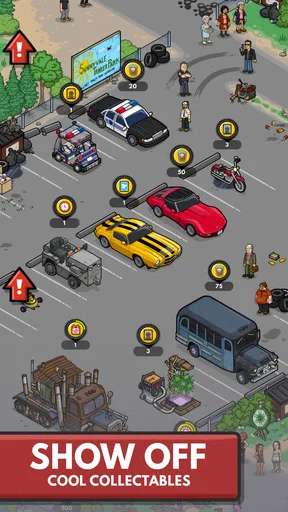
- Many locations and characters provide long-term collection goals.
- Free download with optional purchases rather than a mandatory upfront cost.
Limitations of Trailer Park Boys:Greasy Money
- Frequent ads can interrupt progress unless you pay to remove or reduce them.
- Advancement becomes increasingly dependent on waiting or spending premium currency.
- Limited direct control may feel repetitive for players wanting active gameplay.
- Some content and upgrades are locked behind timers or in-app purchases.
- Requires an internet connection for several features and progression systems.
Other Releases by East Side Games Studio
View All
The Office: Somehow We Manage
Simulation3.4

RuPaul's Drag Race Superstar
Simulation4.3
Similar Picks in This Category
View All
Truckers of Europe 3
Wanda Software4.3

Town Building Life Simulator
XGame Global4.2

Fidget Toys Trading・Pop It 3D
Freeplay Inc4.7

Sculpt People
CrazyLabs LTD4.4

Scary Teacher 3D
Z & K Games4.2

Hair Tattoo: Barber Shop Game
CASUAL AZUR GAMES4.3
Frequently Asked Questions
What is Trailer Park Boys: Greasy Money?
Trailer Park Boys: Greasy Money is an idle management game based on the Canadian comedy series Trailer Park Boys. You help Ricky, Julian, Bubbles, and other characters run Sunnyvale Trailer Park, earn cash, upgrade businesses, and unlock new areas. Much of the progress continues automatically, making it suitable for short sessions as well as longer play periods.
How do you play Trailer Park Boys: Greasy Money?
The main objective is to generate as much money as possible by managing trailer park businesses and improving their production. You collect earnings, hire characters, upgrade buildings, complete missions, and use special boosts to increase profits. The controls are simple and mostly tap-based, so no advanced gaming experience is required, although planning upgrades carefully can help you progress more efficiently.
Is Trailer Park Boys: Greasy Money free to download and play?
Trailer Park Boys: Greasy Money can generally be downloaded for free on supported Android and iOS devices. However, the game includes optional in-app purchases that can provide premium currency, faster progress, or other useful bonuses. You can play without spending money, but free players may need more patience because some upgrades and rewards take time to unlock.
Does Trailer Park Boys: Greasy Money require an internet connection?
An internet connection is recommended and may be required for several important features, including saving progress, receiving updates, watching reward advertisements, accessing events, and synchronizing your account. Offline play may be limited or unavailable depending on the device and game version. For the most reliable experience, launch the game while connected to Wi-Fi or mobile data.
Is Trailer Park Boys: Greasy Money suitable for fans of the TV show?
The game is especially appealing to Trailer Park Boys fans because it includes familiar characters, locations, humor, and references from the series. Even if you have never watched the show, the basic idle-management gameplay is easy to understand. However, longtime fans will likely get more enjoyment from recognizing the personalities and comedic situations featured throughout the game.
Play our best games!


